

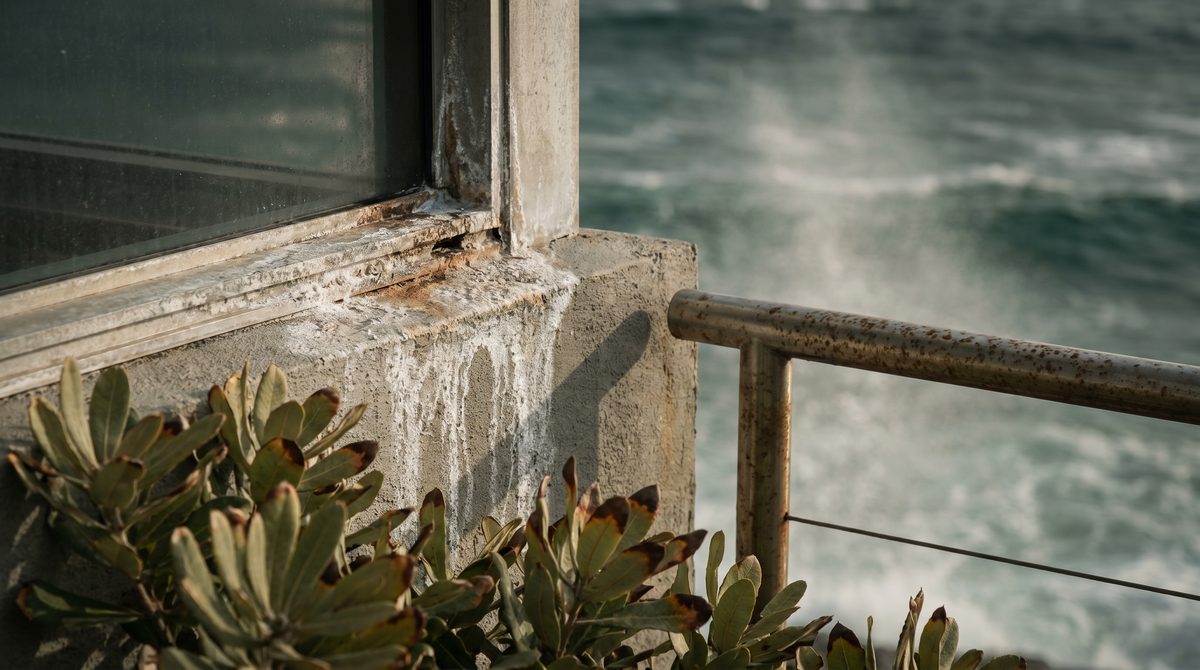
Salt air is the single greatest accelerator of exterior deterioration for properties on the Central Coast and in Newcastle. The combination of airborne salt crystals, elevated humidity, intense UV exposure, and prevailing coastal winds creates an environment that attacks every exterior surface on a building. Left unchecked, salt air damage leads to premature paint failure, metal corrosion, concrete degradation, timber rot, and biological growth that spreads far faster than on comparable inland properties.
For property owners along the NSW coast, understanding how salt air works and what it does to building materials is the first step toward protecting one of your most significant assets.
Why Coastal Properties Face Greater Exterior Damage
Salt does not stay at the beach. Ocean waves breaking along the coastline generate a fine aerosol of salt-laden water droplets that are carried inland by prevailing winds. Research into coastal atmospheric conditions in Australia has established that measurable salt deposition occurs up to 5 kilometres inland from the shoreline, with the highest concentrations found within the first kilometre.
This airborne salt settles on every exterior surface of your property: the roof, walls, windows, gutters, metalwork, timber, and concrete. Once deposited, salt crystals are hygroscopic, meaning they actively draw moisture from the surrounding air. Even on days when it has not rained, a thin film of salt-attracted moisture sits on contaminated surfaces. This persistent dampness is the catalyst for a chain of damaging processes.
The damage is not caused by salt alone. It is the combination effect of salt, humidity, and UV radiation working together. Salt holds moisture against surfaces, humidity prevents that moisture from evaporating, and UV radiation breaks down protective coatings that would otherwise shield the substrate. Individually, each factor is manageable. Together, they create conditions that degrade building materials two to three times faster than in equivalent inland locations.
How Salt Air Damages Different Building Materials
Every material on the exterior of a building responds differently to salt exposure. Understanding these specific vulnerabilities helps property owners prioritise their maintenance efforts.
Metal Surfaces
Metal is among the most vulnerable materials in a coastal environment. Salt accelerates the electrochemical corrosion process that breaks down steel, aluminium, and iron. Gutters, downpipes, roofing screws, flashings, balustrade fixings, and hinges are all at risk. Even stainless steel and galvanised coatings, which are designed to resist corrosion, degrade faster when salt is present.
Colorbond steel roofing and cladding are specifically engineered for Australian conditions, but BlueScope is clear in their documentation that regular cleaning is required to maintain performance in coastal zones. Their maintenance guidelines recommend rinsing every six months for properties within 200 metres of breaking surf, and regular washing for properties within the broader coastal zone. Without this maintenance, the protective paint system breaks down, exposing the steel substrate to accelerated corrosion.
The cost of replacing corroded gutters, downpipes, and flashings on a typical Central Coast or Newcastle home can run into thousands of dollars. Replacing a corroded Colorbond roof is significantly more. Regular salt removal through professional cleaning is a fraction of these costs.
Painted Surfaces and Render
Exterior paint systems are designed to protect the substrate beneath them, but salt exposure dramatically shortens their effective lifespan. Salt crystals that settle on painted surfaces draw moisture, which then works its way into micro-cracks in the paint film. As the moisture evaporates during the heat of the day and returns overnight, the repeated expansion and contraction cycle causes the paint to crack, peel, and eventually delaminate from the surface.
Rendered walls face a similar challenge. Both acrylic and cement renders are porous to varying degrees. Salt-laden moisture penetrates the render surface and, as the water evaporates, salt crystals form within the pore structure of the render. These crystals expand as they grow, creating internal pressure that causes the render to crack, blister, and eventually spall away from the wall. This process, known as salt crystallisation, is one of the primary causes of render failure on coastal properties.
Coastal property owners on the Central Coast and in Newcastle commonly report needing to repaint their homes every 5 to 7 years, compared to the 10 to 15 year lifespan that the same paint systems achieve on inland properties. Regular washing to remove salt deposits before they cause damage can extend repainting intervals significantly.
Concrete and Masonry
Concrete driveways, paths, retaining walls, and building foundations are all susceptible to salt damage. The primary mechanism is chloride ingress, where salt-laden moisture penetrates the concrete surface and reaches the steel reinforcement inside. Once chlorides reach the steel, they initiate corrosion, which causes the steel to expand, cracking the surrounding concrete from within. This process, known as concrete cancer, is one of the most expensive structural issues facing coastal property owners.
Surface-level damage is also common. Salt crystallisation within the pore structure of concrete causes surface scaling and spalling, particularly on exposed horizontal surfaces like paths and pool surrounds that are regularly wet and then dry in the sun. Once the surface begins to break down, the rate of deterioration accelerates as more porous material is exposed.
Timber
Timber decking, fencing, pergolas, and window frames in coastal areas face accelerated weathering due to salt exposure. Salt draws moisture into the timber grain, creating conditions for fungal decay and rot to establish. Hardwood timbers that would last 20 to 30 years inland may show significant deterioration within 10 to 15 years in an unprotected coastal environment.
The salt-moisture combination also accelerates the breakdown of timber oils and stains, meaning protective finishes need to be reapplied more frequently. Timber that is not regularly cleaned of salt buildup develops a grey, weathered appearance faster and becomes more susceptible to splitting and cracking as the surface fibres dry out and break down.
Glass
While glass itself is resistant to salt corrosion, salt deposits on windows and glass balustrades create several problems. Salt film reduces clarity and light transmission, and over time, the alkaline nature of salt deposits can etch the glass surface, creating a permanent haze that no amount of cleaning will remove. Window frames, seals, and hardware are also vulnerable. Aluminium window frames, despite their anodised or powder-coated finishes, can develop pitting corrosion when salt is not regularly removed.
Central Coast and Newcastle: Local Conditions That Make It Worse
The Central Coast and Newcastle regions of NSW experience a specific combination of environmental factors that make salt air damage particularly aggressive compared to many other Australian coastal areas.
Prevailing north-easterly winds during the warmer months carry salt-laden air directly onshore across the Central Coast and Newcastle coastlines. Suburbs like Terrigal, Avoca Beach, Wamberal, The Entrance, Toowoon Bay, Bar Beach, Merewether, and Stockton receive the full force of this salt-laden airflow. Properties on elevated positions in suburbs like Copacabana, MacMasters Beach, and Dudley are particularly exposed because their elevation gives them direct line-of-sight to the ocean and no terrain shielding.
Summer storm activity compounds the issue. The Central Coast and Newcastle regularly experience intense summer storms that drive salt spray further inland than normal wind patterns would carry it. During strong easterly or north-easterly storm events, salt deposition has been measured at significant levels 5 kilometres or more from the coastline. Properties in suburbs like Erina, Gosford, Charlestown, and Lambton, which might normally consider themselves beyond the coastal zone, can receive heavy salt deposits during these events.
Sustained high humidity during the warmer months means that salt deposits on building surfaces rarely dry out completely. The Central Coast and Newcastle experience average summer humidity levels between 65 and 80 per cent, creating a near-constant moisture film on salt-contaminated surfaces. This persistent moisture is the primary driver of mould and algae growth, which establishes two to three times faster on coastal properties than on equivalent inland homes.
The lakes and waterways of the Central Coast, including Tuggerah Lake, Brisbane Water, and the network of coastal lagoons, also contribute to elevated humidity levels for properties that are not directly on the ocean but sit near these water bodies. Properties around Woy Woy, Ettalong, Booker Bay, and the shores of Tuggerah Lake experience a combination of salt air from the ocean and elevated humidity from the lake system.
The Hidden Cost of Ignoring Salt Air Damage
Many property owners along the Central Coast and in Newcastle underestimate the cumulative financial impact of salt air damage. Because the deterioration is gradual, it often goes unnoticed until significant damage has occurred and costly repairs are required.
Premature repainting. As noted above, coastal properties typically require repainting every 5 to 7 years compared to 10 to 15 years for inland homes. For a standard three-bedroom house, a full exterior repaint costs between $8,000 and $20,000 depending on the size, access requirements, and surface preparation needed. Over a 30-year period, a coastal property owner who does not clean regularly may spend $30,000 to $60,000 more on repainting than an owner who maintains a regular cleaning schedule.
Roof replacement and repair. Salt accelerates the degradation of roof surfaces, particularly concrete tiles and metal roofing. A concrete tile roof that could last 50 to 60 years with regular maintenance may require replacement after just 30 to 35 years on an unprotected coastal property. Re-roofing a standard home costs between $15,000 and $35,000. Colorbond roof replacement can exceed $25,000.
Gutter and downpipe failure. Corroded gutters and downpipes are one of the most common maintenance issues on coastal properties. Salt attacks the protective coating on steel gutters, and once the base metal is exposed, corrosion accelerates rapidly. Replacing the gutter system on a typical home costs between $2,000 and $6,000. Properties that do not clean gutters regularly may need to replace them every 10 to 15 years instead of the 20 to 25 years they would last with proper maintenance.
Property value reduction. Visible salt damage, including peeling paint, corroded metalwork, stained render, and biological growth, directly affects the perceived value and marketability of a coastal property. Real estate agents consistently report that properties showing exterior deterioration sell for less and take longer to sell than well-maintained equivalents in the same street. In a competitive coastal property market, the difference can be substantial.
How Regular Exterior Cleaning Prevents Salt Damage
The most effective defence against salt air damage is straightforward: remove the salt before it causes harm. Regular professional exterior cleaning removes the salt film, biological growth, and accumulated contaminants that drive deterioration, effectively resetting the damage clock each time.
Recommended cleaning schedule for coastal properties:
| Distance from Coast | Full Exterior Clean | Fresh Water Rinse |
|---|---|---|
| Within 200 metres | Every 6-12 months | Every 3 months |
| 200 metres to 1 kilometre | Every 12 months | Every 6 months |
| 1 to 5 kilometres | Every 12-18 months | As needed after storms |
| Beyond 5 kilometres | Every 18-24 months | Not typically required |
Why softwash is the right method for coastal properties. Softwash cleaning is particularly well suited to coastal property maintenance for several reasons. The low-pressure application removes salt deposits without damaging surfaces that have already been weakened by salt exposure. The cleaning solutions kill mould, algae, and lichen at the root level, providing longer-lasting results than a rinse alone. And the residual chemical action continues to inhibit biological regrowth for months after treatment, which is critical in the high-humidity coastal environment where regrowth can begin within weeks of a pressure-only clean.
High-pressure washing, while effective on hard surfaces like concrete driveways, can cause significant damage to salt-weakened surfaces. Paint that is already beginning to fail, render that has started to crack, and tiles with degraded coatings are all more vulnerable to pressure damage. On coastal properties, the gentler approach of softwash is almost always the safer and more effective choice for roofs, walls, and cladding.
The SOAKD approach. Our SecureClean System was developed with coastal properties specifically in mind. We assess every surface on the property, identify salt damage and vulnerability, and select the appropriate cleaning method for each area. For roofs, walls, and cladding, this is always softwash. For driveways and hard surfaces, we use pressure washing at the appropriate settings. For windows and glass, we use pure water systems that leave no residue. The result is a comprehensive clean that removes salt and biological growth from every surface without causing further damage to materials that salt has already begun to weaken.
We also provide our clients with honest advice about the condition of their property. If we identify damage during our assessment that needs repair, such as corroded flashings, cracked render, or failing paint, we let you know so you can arrange repairs before the next cleaning cycle. Cleaning is maintenance, not repair, and we believe in being upfront about the difference.
Frequently Asked Questions
How far inland does salt air damage extend?
Salt air damage can affect properties up to 5 kilometres inland from the coastline, though the most severe effects occur within 1 kilometre. Prevailing winds, elevation, and local topography all influence how far salt travels. Properties on elevated ridgelines or hills facing the ocean may experience salt exposure equivalent to properties much closer to the shore.
Does Colorbond hold up in coastal areas?
Colorbond steel performs well in coastal areas when properly maintained. BlueScope offers specific Colorbond grades rated for coastal environments, and their warranty requires regular cleaning to remain valid. Properties within 200 metres of breaking surf should be rinsed every six months and professionally cleaned annually. Without this maintenance, the paint system breaks down faster, exposing the steel to corrosion.
How do I know if my property has salt damage?
Common signs include white powdery deposits on surfaces, accelerated paint peeling or chalking, rust stains around metal fixtures, discolouration on rendered walls, and faster-than-expected mould or algae growth. If your metal gutters, screws, or fixtures show corrosion within a few years of installation, salt exposure is the likely cause. A professional exterior assessment can identify early-stage damage before it becomes costly.
Can salt air damage be reversed?
Surface-level salt deposits and early-stage biological growth caused by salt can be removed through professional cleaning. However, structural damage such as corroded metal, spalled concrete, or delaminated render cannot be reversed and requires repair or replacement. The key is to remove salt buildup regularly before it causes permanent damage. Prevention through scheduled cleaning is far more cost-effective than remediation.
How often should coastal properties be cleaned?
Properties within 1 kilometre of the coastline should have a full exterior clean every 12 months, with a fresh water rinse of exposed surfaces every 6 months. Properties between 1 and 5 kilometres inland generally need a full clean every 12 to 18 months. The exact frequency depends on your elevation, wind exposure, surrounding vegetation, and building materials.
Protect Your Coastal Property
If your property is on the Central Coast, in Newcastle, or anywhere along the NSW coastline, salt air is working against your building every day. The damage is gradual, but it is cumulative, and the cost of remediation is always higher than the cost of prevention. A regular professional cleaning schedule is the most practical and cost-effective way to protect your property from salt air deterioration. We offer free, no-obligation assessments for coastal properties across our service area. Get in touch through our contact page or call us on 0418 167 798.